Lake Como: the settings of the Symposiums Towards a Theoretical Biology, 1968-72
The influence of C.H.Waddington's IUBS Symposiums on Alife research and philosophy |
~ MSc Evolutionary and Adaptive Systems :: Summer Term Thesis :: C.Coke-Smyth cc264 at sussex dot ac dot uk ~ |
Lake Como: the settings of the Symposiums Towards a Theoretical Biology, 1968-72
My thesis topic is unusual for an EASy dissertation in that it will not be based around a specific Artificial Intelligence program, robot or simulation, but instead aims to question the value attainable and the thought required behind such simulations in general. The hope therefore of choosing this subject is firstly to better appreciate the science of the biological world behind such works, and secondly to to maximise an aggregate worth of such exercises towards future EASy academics.
The choice of topic is inspired from two directions:-
For the purposes and scope of this thesis, my aim therefore is to outline three of these hypothetical 'simulations', but to do so critically, and against the question "What would Waddington make of this?". More academically, the central question around which this thesis revolves may be stated:- 'given access to the documentation of the Symposiums "Towards a Theoretical Biology", what have we actually learnt since these 'sketches' were outlined so long ago in the luxurious lakeside near-Alpine location? Is it the case that the field has advanced so far as to make such historic events meaningless or is there a problem. As Schad laments, is it that the modern ALife academic, as he suggests of modern biology, "no longer uses his eyes to look directly at nature but views it only through instruments designed to increase his ability to see"[5].
As such, the dissertation will be undertaken in several respects.
My aim is to retain Waddington's identified need for a 'Theoretical Biology', and to question the role of ALife in meeting this need. It is therefore also necessary to review our current understandings of 'Philosophy of Cognitive Science', 'Informatics', 'Artificial Intelligence', 'Cybernetics', 'Genetic Regulation' and 'Morphology' against what was understood in Waddington's day, his strategic goal and whether modern tactics in anyway enable this roadmap to near actually being acheived. I will attempt to partially bridge this issue in the concluding sections of the dissertation.
Conrad Hal Waddington was born to tea planting parents in India, 1905[0]. Moving back to England at the age of four, his later scientific prowess was framed by a healthy interest in fossils, minerals, insects and juvenile chemical experimentation. My curiousity into Waddington's early development however depends crucially upon his education at Clifton College. Approaching Waddington's later work there is evidently a clear 'Arabic' flavour. A touch of the alchemist, of the philosophy of light, of the hidden knowledge acquired through the direct lineage of academia via Greece into the Middle East centuries prior to the European renaissance[6]. The later products of this thought, of for instance Suhrawardi, Ibn Arabi or Al Haytham[7], hold a remarkably penetrating insight not only into Aristotle and early Platonic Greek thought, but also into pre-twentieth century scientific ideas: optics has been studied in great detail, there exists a rich heritage of 'alchemy' (read chemistry), abstract reasoning, algebra and mathematics throughout such foreign literature. My hopes for uncovering Waddington's intellectual roots cannot be easliy illuminated or pinned down to a specific Arabic master or works, other than his Clifton master E.J.Holmyard[8]. This is highlighted at least within his Nature obituary, the noted early influence of Arabic alchemy and Alexandrian Gnosticism. This, in my mind, cannot be underestimated in forming something of the deep enthusuiasm and penetrating insight that Waddington later holds for his scientific oeuvre.
To detail my attention to this point further, I will attempt to justify just what it is about Waddington's writings that I am trying to attribute towards such influence. Primarily therefore, I will suggest the importance of an early introduction to the romance and mysteries of science available from such historic forays. This I argue, would tend to put the future academic's insight into a considerably deeper relation to the history of the ideas he or she ascribes to. Secondly, at Waddington's ability to 'bag' two studentships, philosophy and paleontology, one might wonder at whether his latent talent would have even been able to flourish had one or the other alone held domination. The balance of a strong and integral philosophical line whilst wrestling with Lyell's paleontology[9], or in penetrating the mysteries of ammonite structure and form was surely hugely advangeous in the integrity of his output. Thirdly, even in Waddington's writings, the relations of descriptive terminology and clear turn of phrase lends itself well to what I myself have learnt from a basic reading of arabic grammar. Whereas today many academics can frame their influence among the natural world alone or an interest in cellular genetics, I think that it is hugely important that Waddington's polymath stature is held aloof by a much less superficial appeciation of the formidable history of science. To paraphrase Goethe, who puts it with his usual understated gravitas: The History of Science is Science[10].
The IUBS Symposiums, the historical focus of this thesis, have not been chosen at whim. Even today, with a wealth of biological studies far surpassing those available forty years ago, it is difficult to find a more idyllic example of contemporary scientific prowess. In this section I shall examine the historical situatedness of the Symposiums, with the purpose of arguing in favour of the criticality in their influence. Even in 2009, Waddington's insights are refreshingly tidy, in comparison to even the most up-to-date, and esoterical ALife paper. Even today one can perhaps still judge an academic worth against relative familiarity with the Symposiums. I would contest that this holds at least within AI related disciplines at Sussex and Edinburgh, potentially the two leading think-tanks for Artificial Intelligence in Great Britain today [See www.inf.ed.ac.uk and www.informatics.sussex.ac.uk/research/groups/easy/MSc].
With the benefit of hindsight, I would like to persuade the reader of the influence of the Symposiums against three* key developmental lineages:
* Admittedly this could easily be expanded to five: The influence of a paradigm shift in theoretical physics; and The manufacturing reconstruction of the Western world, noted in brief further on.
I will attempt to summarise these influences against a selection of academic material documented prior to the IUBS events, hopefully in doing so therefore, offering some of the flavour and state-of-play of the era. I will then attempt to investigate more fully the characters within the Symposiums, and the careers-in-brief of at least a few of the invited academics lucky enough to accept attendence.
There is something of a mystery in that one can almost completely ignore material on the subject of Evolution today prior to Watson and Crick[11]. Having discovered the journal Evolution during my background research, dating well beyond 1953, it is embarassing to note the richness of references and scholars Gaylord Simpson[12] annotates from between the advent of Darwinism[13] and the Second World War. The Baldwin Effect, still a puzzle today (despite the dogma of the modern evolutionist), can in fact be traced back as a recognised academic problem to 1896[12]. Whilst Simpson's paper is scholarly enough in breadth and scope to make publication in a journal as prestigious as one would hope Evolution to be, it may still be assessed as 'clumsy' by todays standards. It is difficult to forgive some of the ambiguities of expression and prose that we cannot publish today, simply on the basis of our finer mastery of genetic evolution. This has surely greatly simplified our ability to appreciate the essentially scientific 'subtext' of such works.
Simpson starts with a summary of his understanding of The Baldwin Effect:
| "Characters individually acquired by members of a group of organisms may eventually, under the influence of selection, be reeinforced or replaced by similar hereditary characters. That is the essence of the evolutionary phenomenon here called 'The Baldwin Effect'." |
I find this definition ambiguous for a phenomena so difficult to pigeonhole. Hinton & Nowlan [14] in 1987 relate the effect to Baldwin's words himself:
| "The assumption that acquired characteristics are not inherited is often taken to imply that adaptations that an organism learns during its lifetime cannot guide the course of evolution. This inference is incorrect." (Baldwin, 1896) |
This is surely clearer is elucidating the elusive nature of the puzzle, in indication that learning mechanisms are rooted not in nurture but deeply motivated by genetic sway towards particularly occurences. Simpson does acknowledge wide literature of purported examples of the effect: calluses in veterbrate such as the ostrich, the butterfly Kallima and others, yet clearly avoids taking any example as definitive of 'the effect' itself. The closest he comes to a pithy and erudite summation of the phenomena is in stating: "Genetical systems do not directly and rigidly determine the characteristics or organisms but set up reaction ranges within which those characteristics develop"(p.115). With this statement alone he is clearly onside with the modern evolutionist.
Despite his limitations, there is a clear appreciation of traditional Darwinian Evolution, Mendelian inheritance and the terminological paradigm of 'genetics'. This is not marred by the great 'knots' in his language, but he has, clearly, wrestled a great deal with the problem of 'The Baldwin Effect' without perhaps clearly summarising exactly what the effect is in nature. The academic palette of Great Britain in 1953 appears to be more textual, more inheritance-experiment-based. The modern dogmas of philosophy of cognitive science today couldn't be further from the issues Simpson has in trying to elucidate the problems of his day. Lamarckism versus Baldiwin, still a familiar pitfall, is almost unrecognisable in the reasoning employed. The finer points of genetic inheritance within a system of Natural Selection are appreciated not only without the notion of somatic chromosomal storage, but also without the elaborate workbench which is computer simulation, utilised today to lessen such taxations on thought.
There is clearly a strong academic lineage in the interpretation of early Darwinist thought. A theoretically abstract landscape was being rigorously and meticulously probed, utterly blind to the retrospective revelations available post-Watson-and-Crick. I will return to this again in examining the Symposiums (also noting Crick's attendance for Symposium 4) and in the questions they raise of the subject of 'Neo-Darwinism': what it actually means and how it can be interpreted. In reading the article by Simpson, it is clear that caution is still required in interpreting Darwin's ideas in relation to biology; in the validity of the diverse schools of thought held under the modern paradigm.
Gaylord Simpson's paper is not just relevant to a prehistory of Waddington's brevity, to his influential position regarding The Baldwin Effect (read: TBE), and to the latter's superior academic 'grasp'. It serves to illuminate some of the scaffolds, the strategic aspects, of Waddington's thought. As a means of scientific enquiry, TBE's application is something familiar to the most refined and elusive of academics. Goethe, writes Bortoft[10], calls this method the Experimentum Crucis. Rather than being a 'curious appendage' to evolutionary theory, TBE holds a crucial philosophical function. It's presence, it's tough and elusive nature, serves to encapsulate a stronger understanding of the entire subject matter. As a means of philosophical enquiry therefore, it must have been employed, non-consciously at least, in framing much of the notions of Theoretical Biology pursued in the Symposiums. This not only justifies the aloofness of such thought from its 'less theoretical' biological counterpart, but also suggests something of the intentionality of the Symposiums. What at the time may have appeared disorganised, ambitious and chaotic may have enabled the participants not to grasp the significance of the Symposiums themselves, but instead the complexities of their respective disciplines to be progressed at a later date.
I would question also, whether Simpson's ambiguity and confusion of syntax could be ascribed to a significant degree, to his post war working world. From reading Simpson's paper, my impression is that by 1968 the academic landscape was 'clouded' to say the least.
Arber's introduction to the 1946, $2.00, translation of Goethe's Botany[15] has found its way into my prehistory section almost enitrely accidentally. As Sherrington writes in Arber, "Were it not for GOETHE'S poetry, surely it is true to say we should not trouble about his science"(p.68). The bizarre truth is that Goethe was and still is entirely shadowed in scientific circles where he alone was brave enough to hold fast against Newton's corpus on light: considering his ideas erroneous and ignorant[10]. The relevance for the Symposiums, bearing in mind Sherrington's vexation, should not be ignored. The esotericity and inaccessibleness of Goethe's oeuvre surely holds a similar fascination that the Villa Serbelloni functions held: almost exclusively ignored. Despite this, the attentions and quality afforded to the Sussex library copy of this paper demonstrates a keen enthusiasm for the work, one of the "minor classics of botany"(p.73). Moreover, within an academic and not strictly 'poetic' context, Goethe's ideas are actually considered seriously and in detail.
The 'spice of' the presence of Goethe's Botany in 1946, is that it serves to uncover a hidden network of philosophical waterways available to the 1968-1972 biologist/physicist/computer-scientist. Arber assigns Goethe specific influences which may otherwise be held foreign to contemporary Neo-Darwinian explananda. Linnaeus (of 'vulpes vulpes' fame) is held in the highest esteem by Goethe, quoted, "Except SHAKESPEARE and SPINOZA, I am not aware that any man of the past has had such an influence upon me."(p.70). I will leave Arber's piece the full analysis of the Linnaeus attraction. Goethe is further exposed as holding Biblical influence, despite Spinoza's Judaist ambiguities about the meaning and nature of God[16]. Arber highlights SAUL and KISH as Old Testament fascinations within the development of his 'symbolic thought'(p.84).
I cannot close the section on Arber (by proxy also on Goethe), without at least explicitly correlating a faint attraction from the Symposium. Indeed the finest example I may begin to underline is perhaps in the specifity of language expressed by Goethe. Metamorphosis is surprisingly, a GOETHEAN term. Goethe's attention to 'plant form': of the urplanfze[15], is in fact formulated in terminology so modern and sophisticated to be worthy of a Turing paper (see below). The work is short, fleeting and tacitly inaccessible; Yet it cannot be denied that observational effects such as 'normal/progressive versus abnormal/retrograde growth' have a pervasive and acerbicly sensitive relevance to any half decent attempt at understanding epigenetics, gastrulation or, in Goethe's most HOLISTIC[17](p.96) sense: Theoretical Biology.
Further in this essay I will try to draw attention to the strength of the connection in IUBS 'Theoretical Biology'. The Symposium papers, to this author, all express a very personal, perhaps even iconoclastic, attack on conventional biological wisdom: The absence of the GENE in a chromosome world ("The irrelevance of genes" [3]), the seminal fame of Wolpert ("The concept of positional information and pattern formation" [4]), or the seeds to Cairns-Smith's Conan Doyle-fuelled Seven Clues[18]. For the time being however, it is enough to note the international, collaborative flavour of both artefacts: the inclusion of an IUBS essay boldly written in native French without translation ("Une theorie dynamique de la morphogenese",p.152) [1], and Arber's GOETHEAN reference to De Candolle's Organographie(p.82): 'cognate ideas' "Sur la symetrie des plantes"[15].
| "It is thought, however, that the imaginary biological systems which have been treated, and the principles which have been discussed, should be of some help in interpreting real biological forms."The Chemical Basis of Morphogenesis A. M. Turing |
Alan Turing is probably the best known human rights campaigner of his generation. Bletchley Park writes "Turing was a far-sighted genius whose work has even greater relevance today than in his lifetime."[see image below]. Whilst being largely remembered as a computer scientist, his Morphogenesis paper is an impressive combination of technical mathematics and biology.

"The full understanding of this paper requires a good knowledge of mathematics, some biology, and some elementary chemistry" writes the abstract. One only needs to count the number of pages of the paper, discount those advisable for 'good mathematicians only' to fathom just how condensed his intellect is. If that wasn't impressive enough, for anyone interested in MORPHOLOGICAL patterns latentcy throughout/pervasion within nature, it is recommened to have a thorough read through the REFERENCES section. One, two, three, four, five, Six references were sufficient to support Alan's ideas. The last two of these in particular should be attended to:-
|
Waddington, C. H. 1940 Organisers and genes. Cambridge University Press. |
Boden [19] describes Thompson as a "Grandfather of ALife". A term that has, to date, been used sparingly. Imprinting on Oliver Sacks[20] as being one of the finest books of his collection, Thompson's masterwork On Growth and Form[21] is an elegant revelation of the sheer awe of mathematics in Nature. Having passed on 16 years before the first conference, the first British Computer Scientist was astute enough to organise his thoughts not only around D'Arcy but also with Hal. Perhaps therefore I am first in suggesting that Waddington was "Godfather of ALife". Holding 1/6 of Turing's Morphogeneiss references and a firm grasp of Organisers and genes(1940)[22], one cannot dispute his importance to the future of the Artificial Intelligence discipline.
As Boden writes in the encyclopedic Mind as Machine[17], Turing's morphogenesis paper was not only a later 'distraction' from the more obvious role in modern computing, but also something of a sensation to mathematical biology. On the surface, the morphogenesis paper clearly shows how patterns in nature can form against a mathematical basis, much as expounded most clearly by D'Arcy Thompson's pioneering work, but also indicates, crucially, biological insights into embryology. The idea of working out how the embryo might start as a single cell and gradually unravel against a biological algorithm cannot be overstated enough in importance to a modern view of gastrulation (see Lewis Wolpert's piece in Symposium 4 (p.83) for Wolpert's well known early exposition of such techniques [4]), let alone embryology and experimental biology in general. Were it not for Turing's sealed position within the history of computer science, his fame may well have rested further from the limelight, but against the clear line of mathematical biologists from Thompson onwards who were the Grandfathers and early relations to one significant modern focii of contemporary ALife research.
The only mystery at this ALife family tree so far is exactly how Goethe, Turing and Thompson managed to be quite so seminal, and yet 'low key' as to be almost exclusively ignored in the popular science of their respective prominences.
So far I have highlighted the scholarly attentions to TBE as being a prime focus of a serious struggle to understand the nature of inheritance in Natural Selection. I have indicated a strong philosophical undercurrent not only via Waddington, but also amongst such classics as Goethe's Metamorphosis. Further I have attempted to connect these clearly in relation to the academic environment at the time of the Symposiums. Clearly Turing, Waddington, Thompson and the legacy of MORPHOLOGICAL THOUGHT offer some idea of the rich resources available to questioning at a time when D.N.A had only recently begun to envelop twentieth century biology.
I would hope that at this stage it is clear that there was a remarkably rich philosophical background at the time of the Symposiums, and that the wealth of material and prolific nature of the 'Grand Masters' prior to the modern scientific age in fact offered a serious advantage over the modern ALife postdoc. Surely the position of ALife is partially as a toolkit for biology[23] and other sciences. The danger of an overconcentrated neologistic research focus, of 'drowning in a sea of state-of-the-art papers' may potentially present a paucity towards any notion of a modern foundational Theoretical Biology. I will close this section optimisitically however, by simply retreating to state that the Symposiums may seriously overshadow corresponding contemporary research, should their Theoretical Biological content be as masterful as their ancestory and nature suggests.
A.G. Cairns-Smith initiates the first Symposium, Prolegomena, with "A Blueprint for a Primitive Organism"[1]. Evidently his line of thought was not without later reward. Seven Clues to the Origin of Life[18] is cited in high esteem by a later Dawkins[24]. The beauty of the work is in situating the problematic first replicators amongst early life on earth. Whilst Cairns-Smith's input into the Symposium is without doubt advanced, it is in this later work that the real fruits of his thoughts become apparent. The book is of the type that has been written to expound a lifetimes study of evolution. It is a Sherlock Holmes-styled mystery into how early cells developed. The depth of discussion and accesibility to the layman has in fact made it a personal favourite, throughout both scientific and prose-based works.
Howard Pattee manages to attend three of the four Symposiums (missing the third although making the write up), and from Waddington's own writings Pattee appears to be the attendee held perhaps in highest esteem. Pattee's statements are bold enough for example as "I shall support the view that the secret of life is hidden in this tension between physical and biologicial description"[1](p.220). "The Physical Basis of Coding and Reliability"[1] is prefaced with a correspondance between Waddington and Pattee, with many of Waddington's essays referrent to Pattee's ideas and works, or at least flagged with such dialogue. Waddington is often wrestling with ideas that appear to originate from Pattee's own conjectures or Waddington's interpretations thereof. Consider "Does Evolution Depend on Random Search?"[1] for just one example of Waddington's involved usage of Pattee's thought.
Pattee's background appears be of molecular biology siding with a strong knowledge of physics. His position throughout the Symposiums is very much to question the foundations of the new subject: "What is a theory of biology?", "What are the physical laws?"[1] and "Does life depend on laws or constraints?"[4]. If anything, my readings of the Symposiums would place Pattee as Waddington's 'Right-Hand Man'. Despite this, Pattee, remains of the 'unknown' variety of academic. His work appears best suited to esoteric referencing and away from the bright lights of popular mainstream academia.
If anyone was the other contender as right hand man, it would be Christopher Longuet-Higgins. Longuet-Higgins managed to attend all four Symposiums, although from the four volume documentation appears to have a role more as facilitator than the authority of Pattee: "A party game of biological replication"[1], or as steersman "What biology is about"[2] and the more wistful and anecdotal later reports of a fictitious discussion between biologist and physicist "The seat of the soul"[3]. Longuet-Higgins was esteemed enough throughout his career to hold academic positions in theoretical chemistry and cognitive science, keeping up with at least one other Symposium attendee, Richard Gregory, both of whom forged pioneering roles in Artificial Intelligence with work on cognition[25] and for Gregory with vision also.
Ernst Mayr acheives an elevated position prior to the Symposiums, being author of "Cause and effect in biology"[1], one of the distributed papers aimed by Waddington to initiate discussions for the Symposiums. Mayr retains his elevated position today as one of the forerunning authorities on modern Neo-Darwinism (see e.g. What Evolution Is? [26]), although his lack of presence at the latter three Symposium's makes one question how comfortable he may have been with the concept of Theoretical Biology itself, other than in his role as facilitator in contemporary understanding of Darwinian evolution.
Richard Lewontin is the second distinguished biologist that should be mentioned for prolificness of later output. He has a more involved position it seems in the Symposiums, writing alongside Waddington in Symposium 1[1] and with the polemic on "The irrelevance of genes"[3] in volume 3. He appears to be from among a group of British biologists at the Symposiums all of whom have been and continue to be hugely influential in the field. John Maynard Smith has acheived great clarity in exposing "Evolution And The Theory of Games"[27] and "The Origins of Life" with Eors Szathmary[28] amongst a series of significant contributions to modern biology, and in fact complimentary to much Psychology and Artificial Intelligence at Sussex. His input and participation at the Symposiums is also mirrored by those of Brian Goodwin and Jack Cowan, also one time Sussex faculty members. Jack Cowan manages to expound ideas on neural nets as they relate to cognitive function: "Stochastic models of neuroelectric activity"[4], whilst Brian Goodwin is another strong biological contributor.
Brian Goodwin acheives several very insightful papers throughout the Symposium proceedings. He provides a preceding summary of topics to be discussed for the second Symposium, to be creatively attacked by Waddington and Pattee. In the third Symposium, he introduces proceedings with the essay "Biological Stability"[3], clearly being held high in the ranks of attendees to end one Symposium and begin a third. It is the final essay however of Symposium Four[4] which shows Goodwin in his true light. The essay ruminantly discusses the progression of science as a whole, discussing Kuhn's work on scientific revolutions and acerbically reintroducing the alchemical roots of which I have earlier ascribed to Waddington. Alchemy, Goodwin writes, was the method of man understanding his personal transformation in the process of his discovery through science. I think that this is a very fitting essay to conclude the Symposiums with, not only demonstrating Waddington's own sympathies but also of the deep and careful reflections of quite an iconoclastic view of modern biology. It saddened me to hear that during the writing of this dissertation, Brian Goodwin, who was lecturing at the holistic Schumacher College in Devon, has passed on and is no longer with us in this world[29].
Among other attendees worth at least brief mention (there are too many to investigate more fully them all), are Lewis Wolpert, with his seminal work on gastrulation present in the Symposium pages, Rene Thom from mathematics, the holistic physicist David Bohm, simplicity to complexity expert Stuart Kauffman, and by then D.N.A. celebrity Francis Crick. Although I cannot identify all of the physicists in attendance, Bohm is an interesting one, for his holistic approach and, from the essays within the Symposiums (highlighted later), his pragmatic approach to the history of physics. It appears that Waddington was definitely selective in choice of invitations, not just looking for a broad collection of academics from a variety of fields, but from particular angles from within each discipline. The list of names are all highly respected within their fields and it is illuminating to note the later fruition of so many of the attendees who may, I would conjecture, have at least boosted their academic standing with the melting-pot-atmosphere of attendence at the symposiums.
| Symposium 1 | Symposium 2 | Symposium 3 | Symposium 4 |
|
|
|
|
| Table 1: A list of attendees at each Symposium | |||
SUMMARY: A theoretical model for vehicle overtaking practice on a three lane motorway
Aim: Identify level of automated real life behaviour.
Machines are capable of, and good at, automated tasks. One only needs to trace the history of IBM, essentially justified by necessity of large scale census machines, to understand the business driver behind the birth and legacy of the computer[30]. Turing was modern in raising the question of machine intelligence. Yes, we can automate, they can play chess but they are not good at unstructured problems[31]. They are not good at 'liking strawberries'[32]. Artificial Life perhaps differs from Aritificial Intelligence in attempting to simulate lifelike aspects within the artefact rather than demonstrating intelligence on the part of the designer: Simon or von Neumann, for example. The difficulty therefore of Artificial Life is the problem of not just, or 'more than' automation[33].
Brooks finds defining intelligence to be iteratively redundant[34]. Clearly the exposure acheived by Brooks early ideas supercedes Waddington's 1970s level theoretical biology in terms of sophistication of foundation to modern Artificial Intelligence. It is unsurpassed historically in both rigour and insight for the contemporary roboticist. Progress has been made. But as if in an economic movement of ideas from boom to recession, we are once again lacking, perhaps, in the creativity and ubiquity of inspired 'intelligent' robots. The function of Artificial Life within this context, therefore, continues to serve as a hi-tech, quasi-real, experimenting ground from which to understand the available acheivements and inherent limitations of computational intelligence. What can we make life-like? What causes us the most software bugs and thought puzzles?.
My aim in considering a motorway simulation is contrary to most of the research on the subject[35,36]. Rather than attempting to master the art of vehicular flow-control, my aim was to question what can be acheived by such a 'mindless' agent. By doing so, my hope, which is at least partially fulfilled, is to elucidate what else is required. If we can suggest and reinforce the notion that computation is unsurpassed in automated computation, what can we say of the limits of such computation, and at what stage can we start to consider ourselves and our own methods of reaching past our robotic selves. Why, if Artificial Intelligence is so sophisticated, can we not build an automated motorway vehicle in real life?
The model submitted as my ALife topic this autumn can be found in the appendix: [APPENDIX#4]. The hypothesis was that by constructing a bare-bones simulation of a three lane traffic system, in as much as my daily homeward commute could be abstracted, the irrationality of the driver agents, the choice of lanes and speed, could be understood rationally. The model failed in its targetted aim of clearly identifying the cause of 'middle lane morons'*, however succeeded in demonstrating the intelligence acheivable by a simple automated algorithm in determining basic three-lane-flow.
The ALife agents were spectacular in their obedience to traffic laws, but incredibly stupid in the economics of their decisions - why change down to the slow lane then back up to the fast lane because of one old lady? Are you trying to kill someone? This economy of lane-changing whereby the agent minimises his cognition of the basic-acheivable-underlying-algorithm was the target of my study. The conclusions of the experiment therefore suffice.
* Driver decisions tend to escalate and become regressively neccessitative in a game theory-esque, cumulative response.
So questions Pattee's earnest attempt in Symposium 1 to identify the source material for a formal 'Theoretical Biology' (see Pattee's essay "The physical basis of coding..." [1]). Pattee admits that this is a brash question, but one necessary to the aims of the Symposium. The discussion begins with the proposition that biology is inherently complex. Causality in biology, unlike a modern systematic approach in physics, is not straightforward. Teleological cause and effect are an ongoing theme of the first Symposium. The effect of this ambiguity is an extreme difficulty in trying to encapsualte biological theory into a single binding notion. I beleive that in one form or another this problem still haunts even the most experienced biologist today. My motorway simulation, I shall argue, demonstrates a stripped down simulation of such a 'complex environment', of cause and effect: lane change decisions, irrationality, and a simple, automated approximation of 'life': of agents in such inherently complex conditions. My arguement is that the simulation is lifelike in a biological sense on the grounds that I have replicated a relationship familiar to Waddington's theoretical biology. Throughout this section I will attempt to draw the real, yet subtle, similarities of a contemporary attempt at ALife with the zeitgeist of Waddington's four symposiums. The motorway, in my mind at least, can abstractly and analagously bring the realm of theoretical biological thinking back to the issues raised in Waddington's economic boom of conferences. The approach of Waddington is important as it surfaces serious chinks in the armour of contemporary biology. Issues such as the Baldwin effect, placebo effects in blood flow; learning in the most fundamental, biological sense of the word.
The intelligence of the motorway, which I originally anticipated to extend in sophistication, was only most-economically possible by introducing memory. To return to my homeward commute, I believe that aside from my continually improving automated response, my intelligence can be attributed purely to a combination of memory and of representation. I should expand at length on these points before returning to the relevance of the Symposiums.
In order to improve my skills as a commuting motorway driver I need to at least recall my route. I would hope that this minimum requirement is immediately apparent (if not immediately observed). Furthermore, with an infinite volume of real-world detail available to my human capacities[see below], I cannot recall everything. My strategy as an agent therefore, is to retain my automated behaviour until I get to the costly processing events, such as overtaking old ladies in the middle lane (Fodor's grandmother may be considered at this point if you are philosophically inclined[37]). If I am really intelligent however, I will not automate my 'old-lady-overtaking' response into my behaviour*. Instead, I will work systematically. I will attempt to statistically increase my memory of my route and the points at which the decisions become sufficiently complex to tax my thought. Perhaps the old ladies are not all the way along the motorway, if they travel this route at all?** My strategy therefore, always open to alternatives, is to focus on the most complex part of my route where the most lane change decisions and thought-effort are required. In my case it is the approach to the M25 circular around London. As I approach London and continue, I can improve my rational, automated behaviour with a simple conclusion:
Statistically speaking I can actually improve this statement even more, given enough empirical foundation. As I never leave along the M25, I almost always end up spending the whole part of the journey in the fast lane. Experience verfies this most emprically. As long as I am statistically careful therefore, and as long as I retain some level of contingency e.g. if a police chase or accident occurs, I can therefore be more bold and suggest the following:
Thankfully enough, this strategy works remarkably well (on 99.99% of Normally Distributed journeys), and I am quite content to live with 0.001% angry, tailing, white-vans, porsches and boy-racers as a mostly law-abiding academic and business analyst.
* My human instinct here is to analsyse only the M25 section in terms of relative complexity.
** At this point I should note that the exit before the M25 to Wisley Horticultural Gardens may well posit an increase in 'old ladies' on the motorway.
To return to the main point, my arguement is that I can improve my route with memory and representation. I will now attempt to justify how and what I mean by representation and why it is mandatory for my ALife experiment to work.
My Masters degree at Sussex has probably been the most anticipated year in my working life. I have carefully stalked the departments web pages for book recommendations, lazily doing background checks on various staff, and networking with relatives for financial support and tips on funding. Inman Harvey, my guide for two sucessive year-visits, both unofficial, was something of a legend even before I found Sussex online (2004 maybe?). Having sat through two taught terms of Inman's 'child': the Evolutionary and Adaptive Systems assault course www.informatics.sussex.ac.uk/research/groups/easy/MSc, I have discovered that the child is so sophisticated these days, to be almost beyond Inman's control (intentionally so perhaps?). Gaining time in Inman's office is almost impossible. It can however be resolutely achieved by mentioning a single word. It isnt a difficult word, one would ruminate. It has been used in a range of academic fields as a kind of collaborative glue for the not-yet-worked-out for many, many years, not to mention the scholarly aspects and insights of art-history [38,39]. But yet, the word that gets my Brooks mentor[40] so irrate is simple: REPRESENTATION. To say it is the holy grail of the psychological and cognitive science disciplines may be half-true, yet mere mention will almost certainly raise only a sneer in all but the most guarded conversations.
The problem: what does representation actually mean? The solution: you tell me the answer, then I will ask an equally distinguished academic, who will disagree or correct at least one aspect of your description. The arguement is also perhaps available to A level students of various 'proper' disciplines as being the ( objective | subjective ) debate.
The cause of Inman's ire however is actually quite understandable. To a roboticist, particularly one of the Brooks persuasion, representation is a useful term for the repository. There is a namespace however in which it is nonsensical: in debugging the Good Robot. It is in fact positively pollutative in trying to let the robot fend for itself. Philosophically speaking, Inman acheives holds a fortified position on the high ground: if you can prove your robot's representational abilities, it is in fact game over. The robot's personal, subjective opinion about its square, circle, sine-wave intelligence, it's internal picture, is inaccessible no matter what question is put to it. My arguement for representation therefore, I can only accomplish and actually defend in Inman's company if and only if I can succinctly demonstrate the automation-intelligence divide of my motorway 'middle-lane-morons' (see my term paper "An Alife Approach to Motorway Simulation" for further details of the phenomenon). Hopefully I can avoid the terminoligical confusion long enough to justify my point below.
In order to understand the fine print above, you will first need to recall the previous section entitled 'Memory Of Route'. The importance of representation to a good motorway driver, real or simulated, is in harnessing the memory economically. The force of this arguement cannot be underestimated. My problem of navigating the M25 intersection of the Guildford-to-London A3 motorway is, as with Heraclitus' river, different everytime. My suggestion, and I hope it is at least partially original, is that representation and memory together are the key. Waddington's prolegomena Symposium emphasises DNA as the "physical memory store" of genetics ("Theoretical Biology And Molecular Biology" [1]. Whilst my short, experimental, Python script is somewhat paltry in comparison, my point is actually quite similar. My point is that in order to improve my motorway automaton's proficiency, to minimise cognition, I must somehow get to grips with the order among the chaos: Heraclitus' infinite iterations of motorway journeying. This is where representation fits in.
In order for a robot to appreciate not only its automation, but also its intelligence, it has to somehow organise its memory*. For it to experience the same route daily is one thing, but there is no reassurance that it can recall anything if the environment always changes. My thought experiment is functional therefore in biological terms because it offers an infinite range of variation, a population of organisms utilising a simple, algorithmic response to survive. The evolutionary and interesting aspects of the behaviour is in understanding the causes and reasoning of their inefficiencies. Given enough time, and given an algorithm sufficiently well-adapted to allow for experimental variation, it is possible that a simple motorway automaton can improve his simple behaviour using memory. Because the environment is variable, representation, I argue, is a core requirement. Representation I will formally understand therefore as being "the ability to appreciate through one environmental signal/cue or another that I am nearing the M25, and that I can therefore react to this symbol appropriately". This simple intentionally ambiguous cue therefore can be used to improve my efficiency by triggering my routine: "switch to the fast lane until I am passed the M25". Its really that simple!
* The alternative is to become increasingly complex to allow for old ladies, van drivers, porsches, lorries and everything else that doesnt fit the simple original algorithm. Quite possibly a provably unbounded set.
SUMMARY A discussion of the futility of high powered computer simulations against their mathematical foundation.
Aim: Outline a hypothetical simulation to question the actual value of 'lifelike' simulation.
In order to build up any suggestion of any notion of An ALife Universe one must in my view begin with an analysis of the Universe itself. Fortunately, here on earth, this is a subject that predates modern science. The Western heritage at least, can be traced elegantly back through Medieval Europe and the Middle East[6], to the Greeks, The Babylonians and the Egyptians[41]. The Greeks were so humbled by the experience of the Egyptians that Herodotus describes the greatest of the Greek philosophers as "but a five year old"[41] in comparison to the mysterious power of 'an Egyptian academic'.
For the purposes of the Artificial Universe to be considered in this dissertation, I will keep the philosophy and mathematics as simple as is humanly possible. I will begin by suggesting that a conventional linear notion of time is entirely inadequate in appreciating the inherent complexity of a sufficiently sophisticated replica of The Universe. To clarify what I mean by a 'linear notion of time', imagine a timeline as follows:-
* An interesting aside here is that this forces consideration of the duration of 'a moment'. I am not at present familiar enough with modern Physics to pursue this question further at this stage.
I am arguing that such a simple temporal translation function, essentially, is not at all satisfactory. As is often indicated, the numbers soon become so incontemplatibly enormous as to out number a 20th century estimate of the number of molecules available to agitate in the entire vastness of universal space itself [42].
My contention, and my reason for selecting this hypothetical programming assignment as the second artefact in assessing Waddington's relevance today, is that this banal, flat appreciation of time is transparently computable and effete. This is crucially important because it is therefore immediately enticing to all enthusiastic computer programmers. In particular, and in assessment of my polemic against the quality of simulations produced by the modern ALife postdoc, I am suggesting that we are regressing away from such crucially important ideas as that of Waddington, and devolving once again into a dark age of debugging and badly executed program logic. Do not be misled.
As any low paid (or at least reasonably competent) computer analyst/programmer will verify, as soon as you are presented with a problem that suggests itself to be 'too simple', you are most assuredly in far deeper water than you originally anticipated. My critique therefore rests on the suggestion not of a linear notion of time as expounded above, but of a timeline significantly more complex*.
*See the diagram in the appendix for a loose approximation of the development of non-agent based complexity [APPENDIX#2].
Bernhard Riemann's 'Prime Number exposition', the zeta function hypothesis and his 'music' [43], heard only by the most astute and finely-tuned of modern mathematical minds, of the clear and yet impossibly unfathomable lineage of primes towards infinity [44] is, I would conjecture, infinitiely more appealling (it is actually impossible to make this point without an unintentional pun). I will therefore frame my Artificial Universe as follows:
I will suggest that instead of time proceeding in a linear fashion, we may contemplate the state of the universe at a given time T, represented as the Tth prime in the series (ie. Pi(T)*).
*Pi(T) is in fact a formal mathematical notation for the Tth prime in a series.
| 1 | 2 | 3 | 4 | 5 | 6 | 7 | 8 | 9 | 10 | 11 | 12 | 13 | 14 | 15 | 16 | 17 | 18 | 19 | 20 | 21 | 22 | 23 | 24 | 25 |
| 2 | 3 | 5 | 7 | 11 | 13 | 17 | 19 | 23 | 29 | 31 | 37 | 41 | 43 | 47 | 53 | 59 | 61 | 67 | 71 | 73 | 79 | 83 | 89 | 97 |
Reformulating the number crunching of the Universe using this function transforms the problem far beyond the realms available to contemporary computation. What actually happens is that the sequence of numbers becomes almost random and impossible to predict the next number in the sequence. The effect of this on 'my Universe' is that each new moment is entirely unknown. It may be remarkably close to the previous moment, i.e. when two primes occur two numbers apart, or may result in a significant leap in complexity completely unpredictable to a conventional algorithmic approach to generating the next state. The elegance of the primes is such that at present there is no known algorithm to state with certainty the Nth occurence in the sequence beyond those that have been calculated in advance. The higher primes are at present in the realms of 243112609-1 (about 12.9 million digits, Aug 08) and 237156667-1 (only 11.1 million digits, Sept 08)[45]. My point in bringing in the dimension of Physics is to suggest that even such large numbers may be futile in comprehending a moment by moment appreciation of time since the big bang.
To put the simulation into perspective, perhaps it is sufficient to simply contemplate the vast activity of the first few 'moments' of the universe [46]. Whilst a conventional algorithm could iteratively tick through a linear iteration of moments in a simple Turing complete [32] translation service (ie. compute y as f(x), given x for Our Present), a Pi(T) expression prohibits calculation beyond certain limitations. The complexity of the chain of primes available to calculation insurmountably exceeds current computational capacity. Even with bottle-of-wine winning big numbers being crunched out and verified by some of the most processor intenstive equipment available to the 1980s, this is still potentially not even marginally significant in consideration of, say, the first eight minutes after the big bang.
To pursue this arguement further, I will conjecture a 'representatinal moment' as THE_PRESENT. Because THE_PRESENT (if considered as a member of the lineage of primes from 1,2,3,5,..THE_PRESENT) is exponentialy superior to any imagining of the number of molecules vibrating in the cosmos as we speak, I am entirely confident that without doing the math (just yet), it is enough to recommend prohibition of a sufficiently accurate ALife Universe with an integrity anywhere near that rich, intertwined world in which we find our place in the universe.
My reasoning for suggesting such an unusual approach to an ALife universe is that THE_PRESENT is inherently ultra-complex. I find it far more reasonable to situate a simulated universe if one submits that (a) the state of the universe at present can be conceptualized, and is unimaginably complex, and that (b) to progress from the present state to the next momentary state is therefore calculably prohibitive in the strongest laPlace demon-esque sense.
The beauty of this conception as a Thought Experiment, the relevance to Waddington's Theoretical Biology, is that it illuminates the need for consideration of and far greater caution with the desire to drastically oversimplify the object of study: The Real World we are attempting to understand by means of simulation.
The relevance and relation to the other two Thought Experiments, is that in order to develop an ALife scenario which is sufficiently close to being Theoretically Biological, it is neccessary to aprpreciate such Physical objections to contemporary computation. It is indeed an issue not unfamiliar to the discussions of the symposiums, as will be discussed below.
To bring the thought experiment closer in line to Waddington's thought, I will consider the notion of epigenesis. The abstract landscapes approached and developed in understanding morphogenetics are crucial to contemporary ALife simulation. If we are to utilize Waddington's abstractions of genetic landscapes, surely the physics required necessitate more complex environmental scaffolds in keeping with the above arguement.
Any simplistic, incremental, time-system is insufficient in the sense that the epigenetic environment is surely situated within the more complex of the two universes. Each incremental time step requires an increase in complexity suggestive of the change of Pi(T) to Pi(T+1) rather than of simply T to T+1. The reasoning, again, is that the environment is not linear or static, but rather, as posited in my ALife Universe, likely to become exponentially more complex as each moment passes. I would further conjecture that to therefore appreciate a morphogenetic development within any artificial domain, it is crucial to limit along some sort of lines as follows:
SUMMARY A critical look at how to engineer a robot that 'can see' against the problems identified in the Thought Experiments above.
Aim: Outline a potential visual system for a motorway robot with an aim to apply the conclusions to synthetic vision and philosophy of vision in general.
|
|
The above example from an anecdotal book about robot acheivements highlights something of the optimism of Robotic Vision. Indeed much has been acheived, with significant work in the area of visual systems research acheived by Gregory, Gibson, Marr, and Austin. There are also, to my mind at least, serious problems. Primarily, the problem I anticipate as greatest should I attempt a robot visual system is The Frame Problem [31]. The goals for my visual robot can be summarised as follows:
Marr writes of Gibson: "he did not understand properly what information processing was, which lead him to seriously underestimate the complexity of the information-processing problems involved in vision and the consequent subtlety that is necessary in approaching them.". Further on however, Marr usefully explicates Gibson's position: vision being "not to decode signals, nor to interpret messages, nor to accept images nor to organise the sensory input or to process the data", instead to extract information based on a "flowing array of ambient energy"(p29) [48]. This, to my mind, hints at Marr's own position of vision being extension of representational theories of mind(p.6). It also highlights the problem of vision as one of relation to the external information, rather than being any kind of consolidation bank of this 'flowing array'. As I hope to show, this would be entirely commensurate with my motorway automaton and its representational approach to environmental situatedness.
To return to The Frame Problem (read: TFP), the example cited for the Good Robot, suggests an example of a bomb diffusal. The robot has a set of operations designed to diffuse a bomb in a room. Unfortunately the situation of the robot depends on a limited appreciation of its environment. As soon as the environment becomes more complex, e.g. the bomb is on the trolley, it becomes clear that the complexity of a real world environment means that greater and greater flexibility and programming are required to further interpret the environmental nuances. It is not without coincidence that this is similar to my complex lane change decision-maker, who submits to a simplified system given an inherent complexity of environment.
My conclusion from TH-1 was that memory of events is required, but not the ability to recursively recall everything. The motorway driver, for example, can clearly see trees passing by without having to question his intellect recursively on everything he knows of THE LARCH. The Frame Problem is avoided by focusing attention on THE DRIVING SYSTEM. Paradoxically the driver is open to experience a near infinite appreciation of trees, hot air balloons, planes and whatever else may encroach upon his immediate environment. This strange nature of memory is dealt with in a fascinating way in Luria's Mind of a Mnemonist [49], whereby the Mnemonist's vast memory actually inhibits his ability to interact 'normally' with the real world, instead finding himself unable to even read poetry without every word forming highly suggestive relations to his prodigious memory.
I will continue to relate to the motorway system to understand my critical approach to vision. I can quite calmly appreciate my conscious experience of memory along the route: to recognise against a previous conception[50] of a Red Car, a Lorry, or a Motorway Sign. My experience is so well adapted to the motorway scenario that I can interpret new stretches of road, read new motorway signs, and understand roadworks. But what of my automated driver, who wants to recognise the M25 approach in order to simplify and reduce cognition of his route?
My position, which appears to hold sympathy for Marr's and Gibson's, is that Robot Vision should not recognise and interpret anything. All it needs instead is the ability to experience events. The task of a motorway navigation robot therefore is to pattern match, approximately of course, a REPRESENTATION of events that correlates with e.g. APPROACHING THE M25.
From TH-2, it is clear that the state of the world Pi(T) at time T I am assuming to be so complex as to be impossible, in the same sense as TFP for any organism or automaton, to process. Even a small percentage of the complexities of the immediate environment would, in my imagining, be too mathematically prohibitive. Think multi-dimensional 8 digit powered numbers increasing exponentially within a prime orientated zeta function second by second, and hopefully you may begin to appreciate the vast complexity of the picture I am trying to present.
In order to return necessarily to Towards a Theoretical Biology, I will end this Thought Experiment with the conclusion that through simple yet elegant experiments, the phenomenon of vision in robots can be acheived, and can be based upon contemporary scientific knowledge. The importance of the symposiums is of understanding the theoretical abstraction of the situation, and therefore neccessarily avoiding an overly complex, costly and elaborate visual system in ignorance of the budget-eating frame problem in research. In summary:
To return to the falacy of modern vision, I will state Marr's straw man which, as with the opening example, gives some flavour of the layman's limited understanding of the complexity of visual processing. "'If,' he might say. [he being Marr's layman] 'vision really is an information-processing task, then I should be able to make my computer do it, provided that it has sufficient power, memory, and some way of being connected to a home television camera.'". Marr retorts: "He doesn't want to know about rhodopsin, or the lateral geniculate nucleus, or inhibitory interneurons. He wants to know how to program vision"(p.4). My own retort is that he doesnt want to know about the science of Optics (AlHaytham, Goethe) or the philosophy of vision, but instead wants to capture and process an infinitely unknowable world.
My main curiousity with Waddington's thought in relation to the motorway thought experiment is Waddinton's idea of homeorhesis: "A situation of stable flow" [0]. To me the fact that the motorway is entirely hypothetical in its value lends itself well to contemplation of such a 'stable flow'. The three lanes indicate a sparse complexity within a 'living system'. As such I can quite easily imagine the vehicles not as cars but as e.g. agents in blood flow, or lifeforms along 'a route of life'. Each trip along the motorway can then be imagined as a successive generation.
This analagy is not as trivial as it sounds. If one considers the life of an organism as being a journey along a prescribed route, each route corresponding to variations within an organism's internal and external environment, the learning may be conceived as the events in the route which the organism adapts to. Surely some organisms will adapt better to a homeorhetic flow which is simple, sparse and short in duration. Others will become more complex, encounter more troubled tasks which permit their successful flow, akin perhaps to the epigenetic landscape. Once the organism adapts to its route better than its counterparts, one may suggest that a second generation 'M25-passing' lifeform will survive and replicate better purely because it has mastered a superior and less taxing method of negotiating the M25 intersection. My input on the subject is that the motorway-automaton does this by recognising its local representational state and utilising a developed memory to control its outward behaviour appropriately given what it has previously recalled about its environment. This is something I would very much like to study further under a formal doctorate proposal.
| "What then are the criteria to be satisfied if an ecosystem is not only to be permanent, but is to give rise by evolution to permanent ecosystems of greater species diversity? We have no idea. But the first living organism, with its food supply, had to comprise such as ecosystem if evolution was to lead to increasing complexity" The status of neo-Darwinism (p.89), John Maynard-Smith [1] |
The ALife Universe I have proposed is in danger of perplexing the reader as to its purpose, and its audacity in not isolating a smaller, less significant model of study. My purpose however in its contemplation relates directly to Maynard-Smith's ideas above regarding the relation of organism to environment. The idea of a permanent environment is the one which my thought experiment is designed to be most polemic against. Surely regardless of temporal variations from one instance to the next we must actually assume the environment to constantly change!
Rather than assume such a permanent environment, my proposition is that to consider Theoretical Biology within a more integral context, the entire Universe of the organism, its cosmos perhaps, must be seen as a constantly moving agenda. The increasing complexity, I conjecture, is not of the organism, but instead of the environment. The changes of the organism therefore are not through its own evolution, but instead the way that it catches the wave of external change from one generation to the next, and has to somehow survive and stay the same as the Universe around it develops. As in the rough sketch in the appendix, my intention therefore is to consider a Theoretical Biology where the internal order of the organism is an attempt to stabilise its genotype, to maintain its own homeostasis, whilst the cosmos around it progresses through its infinite variation.
David Bohm's ruminations on the metaphysics of the Symposium's content seems to reflect this. "The survival of the organism depends on two levels of harmony: (a) Within the organism itself, and (b) In the relation between the organism and its environment." Further remarks on order (p.47), Bohm [2]. The discussion is of the notion of metaphysics and what we can learn from it for science in general, in this context indeed Towards a Theoretical Biology.
What I interpret this to mean is a reinforcement of the organism's need to stabilise it's own 'homeorhesis', of its route along it's road of life, and also of it's relation within its own microcosm to the expanding universe that I am trying to explain in TH-2. In effect my arguement therefore is that to contemplate an ALife organism, it is necessary to suggest not only that the organism must evolve, but that the environment in which the organism necessitively survives must be considered to have a complex harmony of its own. This harmony I am suggesting by the temporal relation not just of linear time, but of a 'prime complexity' of the external environment constantly expanding as outlined above.
In the essay "Does Evolution Depend on Random Search?"[1] an analagy is made between the physical structures building an organism and the overlying order itself. The comparison is with the pebbles in a stream, and the stones which make a bridge. Waddington makes a compelling philosophical arguement that the structures which are formed from the pebbles, from the stones, are complex and real and maintained in a way separate from the underyling structure itself. In the same way he argues, the chemical world underneath the lifelike organism is different from the order of the organism.
Using this same analagy it is clear that in a sense the BRIDGE and STREAM are representations: ways of appreciating groups of lower orders together to initiate certain classes of behaviours towards them. In this sense LEARNING is a way of representing, recalling and recategorising aspects of the world for the benefits of a living system: to maintain a harmony internally and with the outside world.
Adaptations to the environment must ultimately have been based on a very simple initial level of order. Their aim would have been to acquire food/resources and to replicate their physical memory to a new generation. Through a temporal dimension, both organism and world become more complex, i.e. EVOLVE, yet each plan is limited. Each new complexity to the plan is inextricably bound to it's predecessor and will eventually merely distort the early predecessor's inherited memory within the new complexity to accomodate the later generation's learning.
The concept of genetic assimilation is important is recognising that the old physical memory structures develop more and more complex morphological patterns of embryology to adapt more and more to the later complexities of the new world (see appendix for a brief sketch here). As such, genetic assimilation or TBE becomes useful in seeing that recent learning necessarily adapts the many-times-iterated genetic algorithms, and that as the algorithms themselves develop over time, become more and more adapted to the later complexities... the early forms becoming more and more succinct 'bauplans' within the code.
The Thought Experiment on Vision is important in terms of understanding Theoretical Biology because it demonstrates (a) The difficulty of appreciating the sensory world for the organism, and (b) a route to understanding the sensory world through LEARNING. The method of learning which I am searching for in this paper is of REPRESENTING or somehow recognising an aspect of 'life's journey' which becomes sufficiently taxing. Once it can be somehow represented, e.g. visually (or perhaps even with smell or sonar!), and importantly over several iterations, the organism can then instinctively deal with the representation using the method it recalls as being the most efficient given the problem.
What I am trying to suggest is that my three thought experiments function in relation to the Symposiums as follows:
Waddington introduces his Symposiums to his prospective attendees for the original conference with two papers and the intention that:
| "Discussions would be concerned, not with theory of particular biological processes, such as membrane permeability, genetics, neural activity, and so on, but rather with an attempt to discover and formulate general concepts and logical relations characteristic of living as contrasted with inorganic systems; and further, with a consideration of any implications these might have for a general philosophy." Symposium 1 preface [1] |
The papers circulated with comments, one being Waddington's "Basic Ideas of Biology"[1], the other Ernst Mayr's "Cause and Effect in Biology"[1] were aimed at fuelling input into the events. Clearly the aims then and throughout the four proceedings were to ascertain the fundamentals behind contemporary biological thought. As we have seen, the climate of Theoretical Biology, should we be bold enough to assert that it existed at this time*, was influenced by several causal relations with other disciplines. Not only was biology concerned with the classical Aristotlian views of nature, the romantic sciences of Goethe and Darwin, but the twentieth century had introduced new relations and disciplines of study. D'Arcy Thompson's mathematical biology[17], Turing's morphogenesis advance of these ideas, the advent of D.N.A. and cellular experimental sciences, and advances in knowledge of theoretical physics. For this reason I feel it is crucial that the Symposiums fused such sparse areas of knowledge under a single mantle.
* The Journal of Theoretical Biology had initiated publication by 1961.
Waddington clearly asserted his role as one of formulating a strategy for the new synthesis, rather than being concered merely with 'tactics'[51]. The Symposium's benefitted the whole umbrella of disciplines that were involved by focusing on a Knowledge Management[52] approach to the problem. This was acheived by harnessing as much tacit knowledge from as diverse aspects of 'the organisation' as possible, and focusing these forward on a serious attempt to synthesize a series of remarkable ideas under a single term: Theoretical Biology.
In relation to the post war world in which these conferences took place, albeit a decade or two later, it is to me reminiscent of W. Edwards Deming's influence on post-war Japan in rebuilding their economy. Deming focused on a strict statistical manufacturing philosophy which became the underpinning of much of the later ideas as J.I.T. Manufacturing, Statistical Process Control, and other techniques devised through troubleshooting the aftermath of the Second World War and in rebuilding an economy with an integral scientific and philosophically sound basis[53]. These ideas are almost an industrial parallel to the transformations that I would conjecture Waddington was acheiving within his new found discipline of Theoretical Biology.
| "And now, I said, let me show in a figure how far our nature is enlightened or unenlightened"[54] |
I will be brief in my conclusions, since unfortunately (as Ezequiel Di Paolo notes on my Intelligence in Animals and Machines submission), my writing style is too implicit for me to express all again as elegantly as I would wish. Of Kabir's ocean and a single drop. I will simply return to the Summary section of the introduction in assessing the Quality of modern terminology within 'Philosophy of Cognitive Science'. Clearly each of the terms I would have wished to review then (i.e.~1970) and now (i.e.~2010) have been covered to one degree or other, at least I hope enough within a justifiably naive LOT[37]. It is clear however that humans do still live in the cave[54]. We still play among the shadows and like to give names to what we see which are not always representative of their true and ultimate meanings. Despite this, I have enjoyed this opportunity to understand the pre-D.N.A., pre-COMPUTER history of the discipline I have chosen to undertake a Masters of Science Degree in, and hope that in doing so I have had the opportunity to demonstrate that Theoretical Biology is alive and well, but perhaps in need of a renaissance of its own. A return maybe to the Villa on the shores of Lake Como.
| "All know that the drop merges into the ocean but few know that the ocean merges into the drop. -Kabir, reformer, poet (late 15th century)" |
I would like to thank: God, my family, the stars for making me dream, and my library for helping make my Masters possible. To my supervisor Phil Husbands for playing the role of mentor and teacher exactly as well as was required, and to the Symposium attendees themselves for offering so curious an event to lead to a dissertation almost capable of writing itself. I would also like to thank, on a more serious undertone, the mental health services for enabling me to complete my work in my own time. Next time I wont be so forgiving ;-)
C E Coke-Smyth, 15.04, 12th September 2009
[0] Hal Waddington obit. Nature Magazine.
[1] Waddington, C. H (1968) Towards a Theoretical Biology, Vol 1.
Edinburgh.
[2] Waddington, C. H (1969) Towards a Theoretical Biology, Vol 2.
Edinburgh.
[3] Waddington, C. H (1970) Towards a Theoretical Biology, Vol 3.
Edinburgh.
[4] Waddington, C. H (1972) Towards a Theoretical Biology, Vol 4.
Edinburgh.
[5] Schad, W. (1977) Man and Mammals: towards a biology of form.
Wardorf Press. New York.
[6] O'Leary, D. (2001) How Greek Science Passed to the Arabs.
Goodword Books, India; New Ed.
[7] Adamson, P. & Taylor, R. [eds] (2005) The Cambridge Companion to Arabic Philosophy.
Cambridge University Press.
[8] Holmyard, E.J. (1991) Alchemy.
Dover Publications Inc. New edition.
[9] Lyell, C. (2005) Principles of Geology.
Penguin Classics.
[10] Bortoft, H. (1996) The Wholeness of Nature: Goethe's Way of Science.
Floris Books.
[11] Watson, J. (1968) The Double Helix: A Personal Account of the Discovery of the Structure of DNA.
Touchstone. New York, 2001.
[12] Gaylord Simpson, G. (1953) The Baldwin Effect in Evolution, Vol. 1, No. 2 (Jun. 1953), pp110-117.
Society for the Study of Evolution [http://www.jstor.org/stable/2405746]
[13] Darwin, C. (1998) The Origin of Species.
Oxford World Classics. Oxford University Press. New York.
[14] Hinton, G.E. and Nowlan, S.J. (1987) Learning Can Guide Evolution. Complex Systems v1 (1987) pp 495-502.
[15] Arber, A. (1946) Goethe's Botany in Chronica Botanica, Vol 10, No 2.
Waltham. Mass. USA.
[16] Spinoza, B. (2005) Ethics. Penguin Classics, Strand. London.
[17] Boden, M. (2006). Mind as machine: A history of cognitive science. Oxford: Oxford University
Press.
[18] Cairns-Smith, A. G. (1985) Seven clues to the
origin of life.
Cambridge: Cambridge University Press.
[19] Boden, M. (2008) D'Arcy Thompson: A Grandfather of A-Life in Husbands, P., Holland, O., Wheeler, M. (Eds) (2008) The Mechanical Mind in History.
MIT Press. Cambridge, Massachusetts.
[20] Sacks, O. (1997) The Island of the Colourblind.
Random House, Canada.
[21] Thompson, D. (1917/1942) On Growth and Form.
Cambridge. Cambridge University Press
[22] Waddington, C. H. (1940). Organisers & genes.
Cambridge: Cambridge University Press.
[23] Webb, B. (2008) Animals versus Animats: or why not the real iguana?
University of Edinburgh.
[24] Dawkins, R. (1986) The Blind Watchmaker.
Penguin. St Ives
[25] Obituary: Christopher Longuet-Higgins http://www.guardian.co.uk/news/2004/jun/10/guardianobituaries.highereducation [Accessed 1st September 2009]
[26] Mayr, E (2001) What Evolution Is.
Basic Books. New York.
[27] Maynard Smith, J. (1982d) Evolution and the Theory of Games. Cambridge University Press.
[28] Maynard Smith, J. and Szathmáry, E. (1999) The Origins of Life: From the Birth of Life to the Origin of Language. Oxford: Oxford University Press.
[29] Obituary | Brian Goodwin http://www.guardian.co.uk/theguardian/2009/aug/09/brian-goodwin-obituary [Accessed 1st September 2009]
[30] Dyson, G. ()1997) Darwin Among The Machines: the evolution of global intelligence.
Basic Books. New York
[31] Dennett, D., (1998) Cognitive Wheels: The Frame Problem of AI. in Brainchildren, Essays on
Designing Minds, MIT Press and Penguin, 1998.
[32] Turing, A. M (1950) Computing machinery and intelligence. Mind, 59, 433-460.
[33] Ray, T. S. 1994. An evolutionary approach to synthetic biology: Zen and the art of creating life
[34] Brooks, R. A. (1991) Intelligence Without Reason. In Proceedings of the Twelveth International
Joint Conference on Artificial Intelligence, pp 569 – 595. Sam Mateo, California: Morgan
Kauffman.
[35] Lieu, H. (1999) Traffic-Flow Theory. [online] Virginia, Turner-Fairbank Highway Research Center. Available from http://www.tfhrc.gov/pubrds/janfeb99/traffic.htm [Accessed 23 January 2009].
[36] Treiber, M; Hennecke, A; Helbing, D (2000) "Congested traffic states in empirical observations and microscopic simulations", Physical Review E 62 (2): 1805–1824.
[37] Fodor, J. (1990) A Theory of Content 1: The Problem. In his A Theory of Content and Other Essays, MIT Press
[38] Gombrich, E (1950) The Story of Art. London: Phaidon
[39] Gombrich, E (1960) Art and Illusion. A Study in the Psychology of Pictorial Representation. London: Phaidon
[40] Harvey, I., P., H., Cliff, D., Thompson, A., & Jakobi, N. (1997)
"Evolutionary robotics: The Sussex approach". In Robotics and Autonomous Systems, 20, 207 – 224.
[41] Chapman, A. (2002) Gods in the Sky: Astronomy from the Ancients to the Enlightenment.
Channel 4 Books.
[42] Schrödinger, E. (1946) What is Life? Macmillan.
[43] du Sautoy, M. (2003) The Music of the Primes. Harper.
[44] Hardy, G.H. (1940) A Mathematician's Apology, Cambridge University Press.
[45]The Largest Known Primes online at http://primes.utm.edu/largest.html [last accessed 2nd September 2009]
[46] Islam, J.N. (1983). The Ultimate Fate of the Universe. Cambridge.
[47] Simons, G. (1984) Computer Bits and Pieces: A Compendium of Curiousities. Penguin Books. Middlesex.
[48] Marr, D. (1982) Vision: A Computational Investigation into the Human Representation and Processing of Visual Information. W. H. Freeman and Co. San Francisco.
[49] Luria, A. R. (1968). The Mind of a Mnemonist, Harvard.
[50] McDowell, J. (1994) Mind and World. Harvard University Press.
[51] Waddington, C. H. (1961) The Nature of Life. George Allen & Unwin Ltd, London.
[52] Nonaka, I. and Takeuchi, H. (1991), "The knowledge creating company", Harvard Business Review 69 (6 Nov-Dec): 96-104
[53] Neave, Henry R (1990). The Deming Dimension. SPC Press, Inc.
[54] Jowett (1888) Book VII, The Republic of Plato. Third
Edition. Clarendon Press. Oxford.


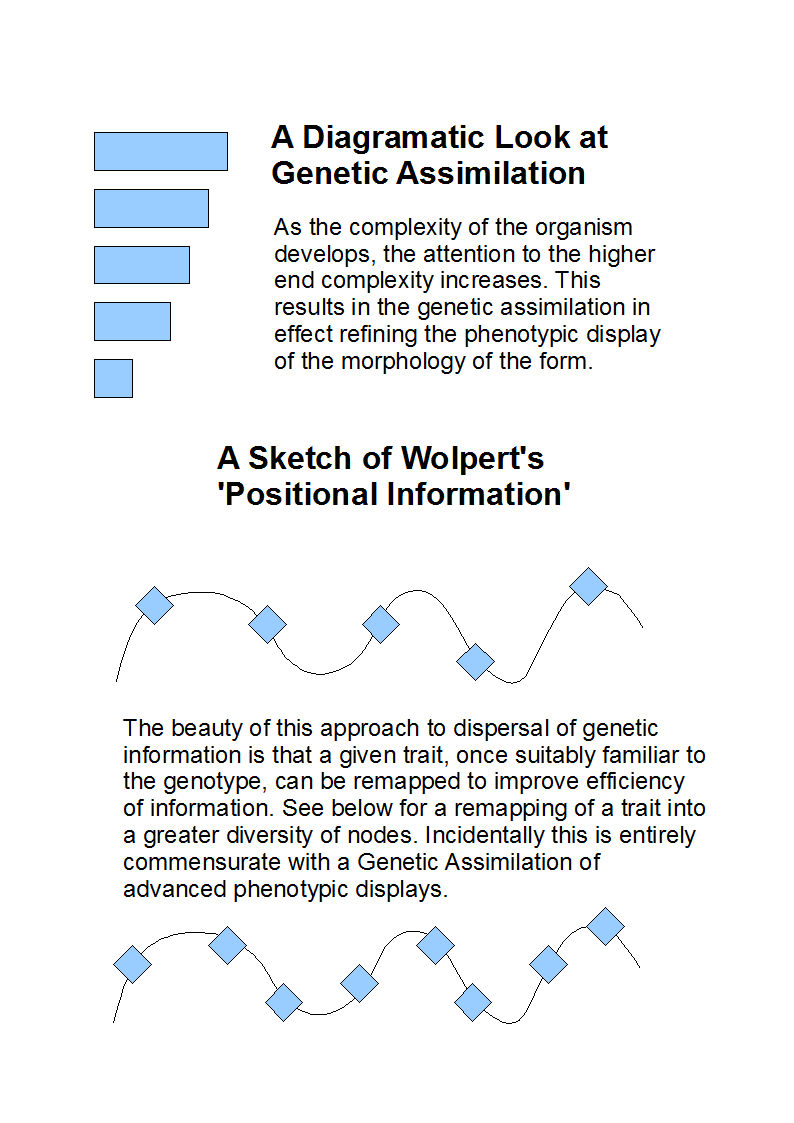
| #!/usr/bin/env python import pygame from pygame.locals import * from sys import exit from time import gmtime, strftime from random import * POP_SIZE = 100 # No of vehicles on the road if there's room SCALE = 1000 # Speed / Animation scale TAU_PARAM = 1.5 # Time of Impact assessment parameter AVG_SPEED = 70.0 # Average vehicle speed Normally Distributed VAR_SPEED = 20.0 # Variance of speed TAIL_DIST = 5.0 # Vehicle matches next vehicle speed at this point CLOSE_DIST = 15.0 # Vehicle starts slowing down at this point def busy(lane,current,space): """Checks *space* available before and after *current* position in a given *lane* """ for pos,actual,desired in lane: if ((pos > current - space) & (pos < current + space)): return 1 def tau(lane,speed,current): """Calculates Time Of Impact for next car in *lane* """ for pos,actual,desired in lane: if(pos > current): distance = pos - current speed_of_approach = speed - actual if((speed_of_approach)>0): return distance / speed_of_approach else: return -1 return TAU_PARAM + 1 def output(item,desc): f=open('output.txt','a') f.write(desc) f.write(': ') f.write(strftime("%a, %d %b %Y %H:%M:%S +0000", gmtime())) f.write(', ') s = str(item) f.write(s) f.write('\n') f.close pygame.init() screen = pygame.display.set_mode((640, 480), 0, 32) # Fill background background = pygame.Surface(screen.get_size()) background = background.convert() background.fill((0, 0, 0)) # Define vehicle appearance vehicle = pygame.Surface((1,1)) vehicle = vehicle.convert() vehicle.fill((200,200,150)) slow_lane = [] middle_lane = [] fast_lane = [] motorway = [slow_lane,middle_lane,fast_lane] # Counter for population on screen pop = 0 # Police car variable police = 0 while True: for event in pygame.event.get(): if event.type == QUIT: exit() if event.type == KEYDOWN: if event.key == K_x: output(motorway, 'Motorway') exit() if event.key == K_s: output(motorway, 'Motorway') if event.key == K_p: if (police == 1): police = 0 else: police = 1 # Add vehicles to road if clear and population below limit if(pop < POP_SIZE): # CLOSE_DIST sets point on screen entry and space each side if not busy(slow_lane, CLOSE_DIST,CLOSE_DIST): speed = gauss(AVG_SPEED,VAR_SPEED) slow_lane += [[ CLOSE_DIST, speed, speed]] # Vehicle defined by [x position on screen, actual speed, desired speed] pop += 1 screen.blit(background, (0,0)) for y,lane in enumerate(motorway): lane.sort() # Update vehicles in lane for index,[pos,actual,desired] in enumerate(lane): moved_lanes = 0 x_pos = round(pos,0) y_pos = 100 + (y*20) screen.blit(vehicle,(x_pos, y_pos)) # For vehicles in lane identify the next position then process any lane / speed decisions if(len(lane)>0): # TODO check whether list should be processed in reverse # Vehicle in front if(index+1==len(lane)): # | (len(lane)==1)): next_pos = lane[0][0] + 640.0 next_speed = lane[0][1] else: next_pos = lane[index+1][0] next_speed = lane[index+1][1] # Vehicle lane change decisions # Police car flag - changes behaviour to 70 max speed if(police): if(desired>70.0): desired = 70.0 # Move down lane? if((actual >= desired) & (y>0)): # next_pos-pos > CLOSE_DIST if((not busy(motorway[y-1],pos,CLOSE_DIST)) & (tau(motorway[y],actual,pos) > TAU_PARAM)): # output(tau(motorway[y],actual,pos),'Tau down lane') # Lane down not busy and next vehicle in current lane is sufficently far away motorway[y-1] += [lane.pop(index)] moved_lanes = 1 # Move up lane? elif((actual < desired) & (y < len(motorway)-1)): # next_pos-pos <= CLOSE_DIST # & (next_speed < desired) if((not busy(motorway[y+1],pos,CLOSE_DIST)) & (0 < tau(motorway[y],actual,pos) <= TAU_PARAM)): # output(tau(motorway[y],actual,pos),'Tau up lane') # lane up not busy and vehicle in front too close and slower and motorway[y+1] += [lane.pop(index)] moved_lanes = 1 # Stay in lane, update speed and position if not moved_lanes: if(next_pos-pos <= TAIL_DIST): #if(tau(motorway[y],actual,pos) <= (TAU_PARAM/15)): # Tailing vehicle in front, match speed actual = next_speed elif((next_pos-pos <= CLOSE_DIST) & (next_speed < actual)): #elif(tau(motorway[y],actual,pos) <= (TAU_PARAM/3)): # Closing in on vehicle in front, slow down actual = (actual+next_speed)/2 elif(actual != desired): # Space available to revert to desired speed actual = desired # Police car flag - changes behaviour to 70 max speed if(police): if(actual>70.0): actual = 70.0 # Update position based on new speed lane[index][0] = pos + (actual/SCALE) lane[index][1] = actual # lane[index][2] = desired :: doesnt change # If the image goes off the end of the screen, move it back if(pos > 640.0): lane[index][0] = pos - 640.0 pygame.display.update() |
|
~last edited: 2009/09/12 15.04 by charles e coke-smyth~ ::2008-9::University of Sussex:: |